A fan coil unit is one of the most widely installed pieces of HVAC equipment in the world, yet most explanations stop at a single paragraph. This guide covers what a fan coil unit is, how it works, the six installation formats available, complete technical specifications across the range, and how to select the right configuration for a project — with the engineering data most manufacturer pages leave out.
A fan coil unit (FCU) is a terminal HVAC device consisting of a heat exchanger coil, a fan, a filter and a housing. It conditions air within a single room or zone by circulating that air across a coil carrying heated or chilled water.
The defining characteristic is what a fan coil unit does not contain: no compressor, no refrigeration cycle, no connection to external ductwork in most configurations. It is a terminal device, entirely dependent on a central plant — a chiller, boiler or heat pump — to supply the water that makes it work.
This simplicity explains its dominance in multi-zone buildings. A 300-room hotel can operate 300 fan coil units, each independently controlled, served by a single central plant. Achieving equivalent zoning with any other technology costs substantially more.
Core components:
The operating principle is direct heat exchange between water and air.
In cooling mode:
In heating mode: the same coil circulates hot water. Traditional boiler systems supply 60°C; heat pump systems typically supply 45°C. The lower temperature produces meaningfully less heat, which is why capacity must be checked at the temperature the plant will actually deliver.
Control. Room temperature is regulated either by modulating water flow through the control valve, or by varying fan speed, or both. Modern EC motor units offer multi-speed or fully variable fan control, allowing the unit to match load precisely rather than cycling between full output and off.
These two terms are frequently confused, including in manufacturer literature.
The practical distinction: a fan coil unit controls temperature in a space. An air handling unit conditions and delivers air to a building. Most commercial buildings use both — AHUs supply tempered fresh air to meet ventilation requirements, while FCUs handle each zone's local heating and cooling load.
Installation format is usually determined by the building fabric rather than by preference.
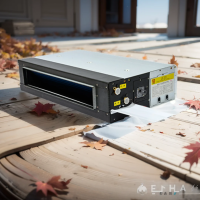
Mounted above a suspended ceiling, ducted to supply and return grilles. The most widely specified format in commercial new-build. Invisible in the finished space, with acoustic performance benefiting from the ceiling void.
Requires: suspended ceiling with adequate plenum depth. Typical use: offices, hotels, hospitals, apartments.
Recessed into the ceiling with a visible decorative panel, discharging air in 2, 4 or 8 directions. No ductwork required.
Requires: exposed grid ceiling, typically 270–300mm depth. Typical use: open-plan offices, retail, restaurants.
A reduced-depth concealed unit for spaces where plenum height is restricted. Some models integrate motorised dampers, allowing one unit to serve several rooms with independent control.
Requires: limited ceiling void. Typical use: retrofits, low floor-to-floor heights, apartment renovations.
Visible within the space, with a finished casing. Modern design-led series achieve noise levels low enough for bedroom use.
Requires: no ceiling void at all. Typical use: heritage buildings, conservatories, retrofits, boutique hospitality.
Floor-standing within a riser or cupboard, ducted to grilles. Common where horizontal ceiling space is unavailable but vertical space exists.
Requires: floor-mounted enclosure. Typical use: apartments, hotel corridors, perimeter zones.
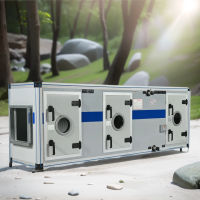
A larger centrifugal-fan unit generating 60–100Pa external residual pressure, capable of serving extended duct runs.
Requires: plant space and ducted distribution. Typical use: large commercial halls, industrial spaces, retail.
Motor technology is the specification decision with the largest effect on operating cost.
AC motors run at fixed speeds — typically three — selected by tapping the motor windings. Proven, inexpensive and simple to service.
EC motors are brushless DC motors with integrated electronics, offering continuously variable speed with substantially lower power consumption, particularly at part load.
The measured difference:
At comparable capacity, the EC unit draws roughly 40% of the power and offers a lower noise floor. Across a hotel with 200 units operating extended hours, that difference compounds into a material operating cost line.
When AC still makes sense: short operating hours, tight capital budgets, no binding energy regulation, and service environments where simplicity is valued over efficiency.
When EC is the right answer: energy compliance requirements, long operating hours, acoustic constraints, or where commissioning flexibility on static pressure is valuable.
Most pages on this topic publish no specification data at all. The tables below cover the main product families.
Adjustable static pressure 0–50Pa.
Static pressure 30Pa.
RS485 master-slave control standard; one unit networks up to 32. Static pressure 12Pa.
Five-speed EC motor, zero static pressure.
External residual pressure 60–100Pa.
2-pipe systems carry either chilled or hot water through one coil, with the building switching seasonally. Lower installed cost, simpler pipework, suitable where the whole building needs the same mode at the same time.
4-pipe systems run separate chilled and hot water circuits, allowing simultaneous heating in one zone and cooling in another. Two coil arrangements exist:
Choose 3+1 where cooling dominates and heating is a shoulder-season requirement; 2+2 where both loads are substantial.
1. Calculate the room load properly. Account for solar gain, glazing, orientation, occupancy, lighting and equipment. Floor-area rules of thumb are for budget estimates only.
2. Set the noise limit before selecting capacity. Hotel guest rooms and hospital consultation rooms typically require below 30 dB(A). Once that limit is fixed, only the compliant fan speeds are available — and that determines which models are genuinely usable. Selecting on capacity first and discovering the acoustic failure at commissioning is expensive.
3. Check available static pressure. Ducted units must overcome duct, filter and grille resistance. Size for the dirty-filter condition, not the clean one.
4. Verify water-side hydraulics. Cross-check water flow and pressure drop against the pump calculation, using the worst-case circuit.
5. Match the format to the building. Ceiling void, plenum depth and architectural intent determine which of the six formats is viable.
6. Confirm heating capacity at the actual supply temperature. On heat pump projects at 45°C, capacity is roughly 60% of the 60°C figure. Check the right column.
Filters — inspect quarterly in commercial settings, monthly in high-dust environments. Clogged filters reduce airflow and capacity.
Coils — clean annually. Dust on the fins acts as thermal insulation; neglected coils can lose 10–20% of rated capacity.
Condensate drains — check before each cooling season. Blockages cause water damage and microbial growth.
Water chemistry — test annually. Corrosion damages coils internally where inspection is impossible.
Fan and bearings — inspect for vibration and noise change, which typically precede failure.
What is the difference between a fan coil unit and an air handling unit? A fan coil unit serves a single room or zone and usually recirculates room air without processing fresh air. An air handling unit serves multiple zones or a whole building, processes outdoor air, and includes multi-stage filtration, dampers and often heat recovery. Most commercial buildings use both.
Can a fan coil unit provide both heating and cooling? Yes. In a 2-pipe system the same coil carries chilled water in summer and hot water in winter, with the building switching seasonally. A 4-pipe system has separate coils, allowing simultaneous heating and cooling in different zones.
How long does a fan coil unit last? Service life depends heavily on water quality, maintenance and duty cycle. Coils fail from internal corrosion when water chemistry is neglected; motors and bearings are the other common wear items. Regular filter changes, annual coil cleaning and annual water testing extend life substantially.
Do fan coil units need ductwork? It depends on format. Cassette and exposed units require none. Concealed horizontal and vertical units are ducted to supply and return grilles, though duct runs are typically short. High-static vertical units are designed for extended duct distribution.
How much space does a fan coil unit need above the ceiling? Standard concealed horizontal units need a plenum deep enough for the unit plus duct connections and service access. Cassette units typically require 270–300mm. Ultra-thin concealed units exist specifically for restricted plenum depths in retrofit work — check the specific model dimensions rather than assuming.
Are fan coil units noisy? Modern EC motor units are very quiet at low speed. The Aura M2 produces 21 dB(A) at Speed 1 — quieter than a whisper. Noise rises with fan speed, so acoustic performance depends on selecting a unit large enough to meet the load at a low speed rather than running a smaller unit at maximum.
What is the typical water temperature for a fan coil unit? Cooling: 7°C supply with 12°C return is the standard design condition. Heating: 60°C in traditional boiler systems, 45°C in heat pump systems. Capacity differs significantly between the two heating temperatures, so confirm which applies to your plant.
Yesncer has manufactured fan coil units since 2008, operating a 40,000㎡ facility with 500,000 units annual capacity and supplying 60+ countries. Every performance figure on this page comes from in-house testing in a national-level enthalpy difference performance laboratory.
[Download Full Product Catalogue (PDF) →] [Request Project Selection Support →] [Contact Our Engineering Team →]