The project involves a pharmaceutical sterile compounding facility designed according to international cleanroom standards.
Key project requirements:
Cleanroom classification: ISO 7 and ISO 8
Application: Pharmaceutical sterile compounding
Ceiling height: 2.7 m
Pressure concept: Positive pressure cascade
Continuous operation: 24/7 HVAC system
To maintain these strict environmental conditions, the HVAC system must provide stable airflow, effective filtration, and reliable humidity control.
In this project, the system design focuses on a dedicated cleanroom AHU system, combined with terminal filtration and controlled airflow distribution.
Selecting the right Air Handling Unit (AHU) is one of the most important tasks for HVAC engineers in pharmaceutical projects.
For this facility, the AHU was designed with the following specifications:
Supply Airflow
Nominal supply airflow: 5000 m³/h
Fresh Air Intake
Fresh air: 500–750 m³/h (10–15%)
External Static Pressure
Minimum: 800 Pa
Preferred: 1000 Pa
The AHU is designed to operate continuously to maintain stable conditions inside the cleanroom areas.
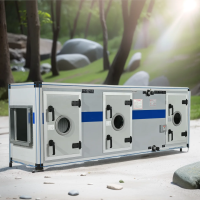
A well-designed AHU for pharmaceutical cleanrooms must include multiple functional sections.
The selected configuration includes:
A mixing box combines fresh air and return air from cleanrooms. Motorized dampers regulate airflow to maintain stable ventilation.
The first filtration stage uses G4 panel filters to remove large airborne particles.
The second stage uses F7 or F8 bag filters, significantly improving air cleanliness before air enters the duct system.
Humidity control is critical for pharmaceutical production.
The AHU includes a chilled water cooling coil designed to remove latent heat and control moisture levels.
Estimated cooling capacity:
9–10 TR
A stainless steel drain pan collects condensation generated during dehumidification.
The unit uses a high-efficiency EC plug fan, providing precise airflow control and improved energy efficiency.
In pharmaceutical cleanroom HVAC design, filtration is typically divided into multiple stages.
Inside the AHU:
Stage 1: G4 pre-filter
Stage 2: F7 / F8 fine filter
However, the final HEPA H13 filters are installed at the terminal ceiling diffusers inside the cleanrooms rather than inside the AHU.
This configuration offers several advantages:
Reduced pressure drop in the AHU
Easier HEPA maintenance
Better contamination control inside cleanroom zones
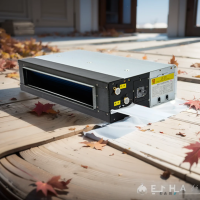
In many pharmaceutical and laboratory HVAC projects, Fan Coil Units (FCU) may also be integrated with the central HVAC system.
While the AHU manages fresh air, filtration, and humidity control, fan coil units can provide:
Local temperature control
Supplemental cooling
Energy-efficient zoning
For engineers designing HVAC systems, combining AHU + Fan Coil Unit solutions can improve flexibility in complex facilities.
Typical HVAC configurations include:
AHU for fresh air and cleanroom airflow
Fan coil units for temperature zoning
Chiller or heat pump for chilled water supply
Modern pharmaceutical HVAC systems require precise monitoring.
This AHU includes:
Fan speed control
Filter differential pressure monitoring
Supply air temperature sensors
Integrated electrical control panel
Interface for BMS / PLC integration
These controls allow engineers and facility managers to maintain stable operating conditions across all cleanroom areas.
Choosing the right AHU design is essential for pharmaceutical facilities.
A properly selected AHU ensures:
Stable airflow for cleanroom classification
Accurate humidity control
Reliable 24/7 operation
Lower long-term maintenance costs
Compliance with ISO 14644 cleanroom standards
For HVAC contractors and consulting engineers, early-stage AHU engineering selection plays a key role in project success.
For global engineering projects, HVAC systems often include multiple equipment types.
Typical equipment selection includes:
Air Handling Units (AHU)
Fan Coil Units
Chillers
Heat Pumps
Ventilation Systems
Each component must be carefully matched to meet the project’s airflow, temperature, and pressure requirements.
Pharmaceutical cleanroom HVAC systems demand high reliability and precise environmental control.
Through proper AHU engineering selection, filtration strategy, and airflow design, HVAC engineers can ensure cleanroom environments remain stable and compliant with international standards.
As pharmaceutical manufacturing continues to expand globally, demand for well-designed cleanroom HVAC systems, AHU solutions, and fan coil unit integration will continue to grow.
If you are working on pharmaceutical, laboratory, or cleanroom HVAC projects, selecting the right AHU and HVAC system configuration is critical to long-term performance and operational stability.
📞 Contact Us for HVAC Engineering Solutions
Website: https://www.yesncer.com
Phone / WhatsApp: +86 159 3124 2194
We provide HVAC equipment and engineering support including:
Air Handling Units (AHU)
Fan Coil Units
Chillers
Heat Pumps
Ventilation Systems